


| Issue |
SICOT-J
Volume 12, 2026
|
|
|---|---|---|
| Article Number | 32 | |
| Number of page(s) | 8 | |
| Section | Knee | |
| DOI | https://doi.org/10.1051/sicotj/2026021 | |
| Published online | 25 May 2026 | |
Review Article
A decade of global orthopaedic research in SICOT-J (2015–2025): a scientometric analysis of publication trends, collaboration, and citation impact
1
Department of Orthopaedics and Joint Replacement Surgery, Indraprastha Apollo Hospitals, Sarita Vihar, New Delhi 110076, India
2
CSIR-NISTADS, Pusa, New Delhi – 110012, India
3
Library and Information Centre, Government First Grade College, Hosapete 583201, Karnataka, India
4
First Department of Orthopaedics, National and Kapodistrian University of Athens, School of Medicine, 15562 Athens, Greece
5
Hôpital de la Croix Rousse, Université Claude Bernard Lyon I, France
6
Young Adult Hip Service, Department of Trauma & Orthopaedics, Addenbrooke’s – Cambridge University Hospital, Cambridge, UK
* Corresponding author: This email address is being protected from spambots. You need JavaScript enabled to view it.
Received:
20
October
2025
Accepted:
27
March
2026
Abstract
Background: The SICOT-J, an open-access orthopedic journal affiliated with the Société Internationale de Chirurgie Orthopédique et de Traumatologie (SICOT), has been a global orthopedic research platform since 2015. This study provides a scientometric analysis of SICOT-J publications from 2015 to 2025 to evaluate research productivity, citation impact, and collaboration patterns. Methods: 542 documents published in SICOT-J and indexed in the Scopus database were analyzed using bibliometric indicators. Data on publication types, subject areas, authorship, institutional and geographic affiliations, funding disclosures, collaboration networks, and citation metrics were extracted. Microsoft Excel was used for data processing and analysis. Key indicators included citations per publication (CPP), relative citation index (RCI), and total link strength (TLS) for collaborative connections. Results: From January 1 2015, to June 30 2025, SICOT-J published 542 articles with an overall CPP of 10.29. Research articles comprised 78.6% of publications, while reviews – though fewer in number – had the highest CPP (23.38). The most frequent topics were arthroplasty (25.83%) and trauma/fractures (24.17%), with the hip and knee as the most studied anatomical regions. Only 5.17% of the articles reported external funding. Fifteen highly cited papers (≥50 citations) were mostly reviews and internationally co-authored. Conclusions: SICOT-J has demonstrated consistent publication growth and international participation, though with notable concentration in a few high-income countries. The high citation impact of reviews and collaborative works highlights the importance of strategic content development. Enhancing funding transparency, supporting underrepresented regions, and promoting emerging topics strengthen the journal’s global impact.
Key words: Bibliometrics / Orthopaedic / Research Collaboration / Publication Trends / Trauma
© The Authors, published by EDP Sciences, 2026
 This is an Open Access article distributed under the terms of the Creative Commons Attribution License (https://creativecommons.org/licenses/by/4.0), which permits unrestricted use, distribution, and reproduction in any medium, provided the original work is properly cited.
Introduction
The evolution of orthopedic research has been significantly shaped by global scholarly output, with speciality journals as critical platforms for disseminating clinical and scientific advancements. SICOT-J (https://www.sicot-j.org/), the official open-access journal of the Société Internationale de Chirurgie Orthopédique et de Traumatologie (SICOT), has emerged as a reputable forum for orthopedic scholarship since its inception in 2015. As orthopedic surgery continues to evolve rapidly – with growing emphasis on arthroplasty, trauma management, minimally invasive procedures, regenerative medicine, and biomechanics – quantitative evaluations of research dissemination have become increasingly essential to guide policy, funding, and clinical practice priorities [1].
Scientometric and bibliometric analyses have become widely adopted tools for evaluating research output, collaboration, and impact across medical fields [2, 3]. Bibliometric methods are valuable for assessing longitudinal publication trends, institutional productivity, international cooperation, and citation influence within specific disciplines [4]. In orthopedics, prior bibliometric studies have examined top-cited articles on several themes [5–11], providing crucial insights into global trends. However, journal-specific scientometric evaluations remain limited [12–14]. Bibliometric analyses tailored to individual journals can reveal granular insights into regional contributions, high-impact authors, and institutional collaboration networks. Moreover, they offer transparency into underrepresented topics or geographies and inform editorial and strategic decisions [15, 16].
This study presents a detailed scientometric analysis of SICOT-J publications from 2015 to 2025, aiming to assess its publication growth, citation performance, thematic and geographic distribution, and collaborative linkages. By analysing 542 Scopus-indexed publications, the study offers an evidence-based appraisal of the journal’s global scientific influence and provides data to guide future orthopedic research directions.
Materials and methods
The global orthopedic documents covered in SICOT-J and indexed in the Scopus database, spanning 11 years from January 1, 2015, to June 30, 2025, were analyzed using bibliometric methods in this study. To identify and download all documents indexed in SICOT-J, a search strategy was developed that used SICOT-J as a source tag and restricted the publication years to 2015-2025, which initially yielded 542 global documents. The search strategy used was: “SRCTITLE (SICOT-J)”.
For each publication record downloaded, the information collected includes author and institution details, funding, collaboration, citations, and publication type/source, all analyzed using MS Excel for data cleaning, preliminary organization, and descriptive statistics; Biblioshny, the web interface of the Bibliometrix R-package, to generate bibliometric indicators and thematic structures; and VOS viewer for constructing and visualizing co-authorship and citation networks. The bibliometric analysis focused on several key indicators: assessing overall publication trends and growth, characterizing publication types and sources, evaluating the extent of external funding and identifying supporting agencies, determining the scope of international collaboration by identifying key countries, organizations, and authors, and analyzing the geographical distribution of publications. Additionally, the study classified papers by broad subject areas, keywords, and organ/bone focus, and identified the top 22 most productive organizations (with ≥13 papers), the top 19 most productive authors (with ≥13 papers), and the top 15 highly cited papers or HCPs (with ≥50 citations).
Results
Annual and cumulative growth of publications in SICOT-J
The SICOT-J witnessed moderate growth in the annual publications, increasing from 34 in 2015 to 59 in 2024, reaching peaks of 73 and 65 in 2016 and 2021 (Figure 1). The total publications (TP), 508, registered an annual average growth rate of 11.85%. However, the 5-year cumulative publications marginally increased from 252 to 256, registering 1.59% absolute growth. Over these 10 years, the journal published 508 articles, achieving 5565 total citations (TC), yielding an overall average of 10.95 citations per publication (CPP). However, the 5-year cumulative citation impact per paper declined from 16.4 during 2015–2019 to 5.95 during 2015–2024 (Table 1). It should be noted, though, that the decline in citation impact is not real, as the publications in the later period did not get enough time to gain citations (“citation lag”).
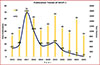 |
Figure 1 Publication and citation trends of SICOT-J from January 1, 2015, to June 30, 2025. |
Annual growth of publications in the SICOT-J (2015–2025).
Research articles were the most common publications (78.60%), followed by the review articles (18.63%). However, review articles received much higher average citations per paper (CPP-23.38), as compared to the research articles (CPP-7.51) (Supplementary Table 1).
Keyword subject analysis reveals that “Arthroplasty” and “Arthroscopy” are the most frequently occurring keywords in 18 papers each (Supplementary Figure 1). This is closely followed by “Osteoarthritis” (11 papers), “Intermedullary Nails (9 papers), “Fractures”, “Rehabilitation” and “Hemiarthroplasty” (7 papers each), “Infection” and Dislocation” (6 papers each), “Trauma”, “Debridement” and Biomechanics” (5 papers each), “Sarcoma”, “Reconstruction”, Prosthetic Joint Infection” and Covid-19 (4 papers each), Osteotomy (3 papers) and Giant Cell Tumor (2 papers) (Supplementary Table 2).
Top countries
Sixty-five countries contributed to SICOT-J publications, with the top 10 nations producing 533 papers and 5,809 citations, accounting for 98.34% of all publications and over 100% of total citations due to international co-authorships. France led with 95 papers, followed by the United Kingdom (UK) (n = 86), Egypt (n = 79), and both India and the United States (US) (n = 54 each). Five countries – Australia, the US, the UK, Germany, and Italy – exceeded the average citation impact (CPP >10.90, RCI >1.06), with Australia achieving the highest CPP (20.09) and RCI (1.95).
France also exhibited the strongest research collaboration with the highest Total Link Strength (TLS) of 154, followed by the UK (76) and Egypt (59). The most frequent bilateral collaboration was between the UK and Egypt (14 linkages), with strong ties also seen between France and Greece (12), and France with both Italy and Australia (10 each), highlighting a robust network of international orthopedic research partnerships. The countries’ collaboration network is divided into three clusters based on co-authorship and citation metrics (Supplementary Figure 2).
The bibliometric details of the top 10 countries publishing in the SICOT-J are presented in Table 2.
Top 10 Countries publishing in SICOT-J (2015–2025).
Top organizations
A total of 313 organisations contributed to publications in SICOT-J between 2015 and 2025, with the top 22 organisations producing 455 papers (83.95% of total output) and receiving 4,452 citations (79.83% of total citations) (Supplementary Table 3).
Nine organisations surpassed the average productivity threshold (≥20.68 papers), led by Université Claude Bernard Lyon 1 (42 papers), Université de Lyon (41), and Hôpital de la Croix-Rousse (40). In terms of citation impact, nine institutions exceeded the average CPP of 9.78 and RCI of 0.95, with Aarhus Universitetshospital, Denmark (CPP 16.64; RCI 1.62) and Addenbrooke’s Hospital, UK (CPP 15.75; RCI 1.53) being the most impactful (Table 3). These findings highlight the strong contribution and influence of a small group of predominantly European institutions in shaping the orthopedic research landscape within SICOT-J.
Bibliometric profile of the top six impactful organizations.
The TLS, indicating research collaboration intensity among the top 22 contributing organisations in SICOT-J, ranged from 13 to 328. The highest TLS was recorded by Université de Lyon, France (328), closely followed by Université Claude Bernard Lyon 1 (327), and Hôpital de la Croix-Rousse (297), all highlighting France’s dominant collaborative presence. Other major French institutions, such as the Fédération Internationale de Football Association (286), Université Gustave Eiffel (284), and Laboratoire de Biomécanique et Mécanique des Chocs (284), also showed strong network centrality. Outside France, notable collaboration metrics were observed in the National and Kapodistrian University of Athens (69 TLS), Cairo University (43), and Addenbrooke’s Hospital, UK (38). The most frequent bilateral collaborations occurred between Université Claude Bernard Lyon 1 and Université de Lyon (38 linkages), followed by partnerships involving Claude Bernard Lyon 1 with Hôpital de la Croix-Rousse, Université Gustave Eiffel, and Laboratoire de Biomécanique (36 linkages each), reflecting a tightly interconnected French research network (Supplementary Figure 3).
Top authors
A total of 1,893 authors contributed to SICOT-J between 2015 and 2025, with the top 19 most productive authors collectively publishing 256 papers and receiving 2,875 citations, accounting for 47.23% of total publications and 51.55% of total citations (Supplementary Table 4). E. Sappey-Marinier (France) ranked as the most impactful author with a CPP of 32.44 and RCI of 3.15. At the same time, other high-impact contributors included V. Khanduja (UK), K. Kaneko (Japan), and J. Shatrov (France) (Table 4). The average international collaboration rate among these leading authors was 50.78%, with wide variability ranging from no collaboration to full international participation.
Bibliometric profile of the top six impactful authors.
Among the top 19 most productive authors in SICOT-J, TLS ranged from 12 to 234. S. Lustig (France) exhibited the highest TLS (234), followed by E. Servien (190), C. Batailler (169), A.F. Mavrogenis (106), and T. Baba (75), indicating strong collaborative influence. The number of bilateral collaborative linkages among these authors ranged from 1 to 35, with the strongest partnership observed between S. Lustig and E. Servien (35 collaborations). Other prominent author pairs included Lustig–Batailler (32 linkages), Servien–Batailler (29), and Lustig–Sappey-Marinier (9), underscoring a tightly interconnected core group of French researchers driving a significant portion of the journal’s collaborative output (Supplementary Figure 4).
Highly-Cited Papers (HCPs)
Between 2015 and 2025, SICOT-J published 542 articles, of which only 15 (2.77%) qualified as HCPs, each receiving 50 or more citations. These HCPs were published between 2017 and 2022, collectively garnered 1,473 citations, averaging 98.2 CPP. Most of these papers (11) fell within the 51–88 citation range, while the remaining four achieved between 100 and 395 citations. The majority were published in 2017 (10 papers) and 2021 (2 papers), and the collection included 12 reviews and 3 original research articles, highlighting the higher citation impact of review publications. Collaboration was prominent in 10 of these papers (3 national and 7 international), with the US and UK involved in four each, and Australia and France in three; only five papers (33.3%) were authored by single institutions. Contributions came from 59 authors and 41 institutions, with top-producing institutions including Hôpital de la Croix-Rousse, Université Claude Bernard Lyon 1, Université de Lyon (France), and Chandigarh (India) – each involved in two HCPs that collectively received 213 citations. S. Lustig and E. Servien were the leading contributors, each co-authoring two of the top-cited papers. Full bibliographic details of the top 15 HCPs are provided in Table 5.
Bibliometric profile of the top 15 Highly Cited Papers of SICOT-J.
Discussion
This scientometric analysis provides a comprehensive overview of SICOT-J’s publication and citation performance over the last decade (2015–2025), examining 542 documents indexed in Scopus. The findings indicate a moderately growing publication trajectory, a diverse thematic and geographic distribution, and evolving trends in orthopedic research focus, authorship, collaboration, and citation impact. The average CPP of SICOT-J publications was 10.29. Research Articles constituted the majority of publications (78.6%), with reviews representing a smaller share (18.6%) but demonstrating the highest citation impact (CPP: 23.38). The most productive subjects included arthroplasty (25.83%) and trauma (24.17%), aligning with broader orthopedic priorities. Regionally, hip and knee topics dominated publication frequency and citation impact. Prominent contributors included authors from France, the UK, Egypt, India, and the US. Only 5.17% of papers acknowledged external funding, and a small proportion (2.77%) of the articles qualified as HCPs with ≥50 citations.
The results of this study align with previously published bibliometric research in orthopedics [8–10, 12], which consistently report that review articles and collaborative publications accrue higher citations than individual or non-review studies. Additionally, reviews comprise a minority of orthopedic publications but dominate citation count due to their summative nature and utility for clinical practice and policy development [17, 18]. Studies have revealed a growing trend in international collaboration and emphasized the substantial citation impact of co-authored papers [5, 19]. The dominance of arthroplasty and trauma as thematic areas is consistent with other journal-focused analyses. Hip and Knee arthroplasty, trauma, and sports injuries were found to be the most frequent research areas in East Asian orthopedic journals, mirroring the focus in SICOT-J [5, 19]. These findings reflect these conditions’ high clinical and economic burden globally and the ongoing need for innovation and evidence-based management [20].
The low rate of funded studies (5.17%) is lower than those reported in broader biomedical fields, where funding disclosures often range from 15% to 30% depending on region and field [21]. This may point to a relative underinvestment in the orthopedic research published in SICOT-J, or underreporting of funding sources. The international distribution of contributors – dominated by high-income countries (HICs) – follows known patterns in orthopedic literature [14]. According to Sweileh et al., low- and middle-income countries (LMICs) are often underrepresented in orthopedic research due to limited research infrastructure and funding [3, 15]. Nonetheless, SICOT-J demonstrates commendable international engagement, with contributions from 65 countries and productive hubs in Egypt and India, suggesting a degree of openness and global inclusivity.
Identifying HCPs concentrated between 2017 and 2022 also parallels trends in citation dynamics. As noted by Hirsch and confirmed in several citation analyses, papers typically receive the majority of their citations within the first 3–5 years of publication [21]. Most HCPs in SICOT-J were reviews, often involving international collaboration – another known predictor of higher citation impact [22].
With contributions from over 65 countries, SICOT-J promotes global collaboration and accessibility, reflecting the society’s mission to improve orthopedic care worldwide. The journal is indexed in major databases, including Scopus, PubMed Central, and Web of Science, and has steadily gained recognition through increasing citation metrics and international authorship. Over the past decade, SICOT-J has steadily increased its academic footprint, reflected in several journal-level metrics. According to Clarivate’s Journal Citation Reports (2025), the journal’s 2024 Journal Impact Factor (JIF) and 5-year JIF stand at 2.3. In Scopus, the CiteScore has risen from 1.7 in 2020 to 3.4 in 2024 (Supplementary Figure 5), ranking 159/568 in surgery and 127/332 in Orthopadics & Sports Medicine (Q2) (https://www.sicot-j.org/). These metrics collectively indicate that SICOT-J has evolved from a niche open-access title into a well-regarded venue for orthopedic scholarship, earning improved visibility, citation influence, and global reach over time.
Study’s limitations
Despite its strengths, several limitations must be acknowledged. First, the study relies solely on Scopus-indexed data, potentially omitting relevant papers not captured in that database. Although Scopus offers wide coverage, some discrepancies in indexing practices may affect completeness. Second, the citation analysis may be skewed for recent publications (2023–2025) due to the time lag in citation accrual. As noted by Bornmann and Daniel, citation metrics are temporally biased, and newer papers inherently have fewer citations [23]. Another limitation is the exclusive focus on quantitative indicators without a qualitative content assessment. Citation counts do not always reflect scientific quality or clinical relevance [24]. As our analysis relied on Scopus metadata, which classifies articles broadly as “Review,” it was not possible to reliably differentiate between subtypes such as systematic reviews, meta-analyses, and narrative reviews. Moreover, the study does not assess altmetrics or social media influence, which are increasingly used to gauge research dissemination and impact beyond academia [25]. Finally, the low reporting of funding information may reflect actual funding scarcity or underreporting, limiting the ability to correlate funding with research impact comprehensively.
To enhance the visibility and influence of orthopedic research, SICOT-J should adopt a multifaceted strategy. Promoting high-impact narrative and systematic reviews in emerging subfields can increase citation potential and readership, as such articles often synthesize evidence and guide clinical practice. Fostering international and South-South collaborations can improve research equity and diversity, particularly by engaging LMIC researchers who are often underrepresented in the orthopedic literature [14, 26]. Improving transparency in funding disclosures through stricter reporting standards can facilitate accountability and promote trust in research outputs [27]. Leveraging altmetrics and digital dissemination – such as social media activity and online attention scores – offers complementary insights into a study’s real-world influence beyond citations [28]. Special issues on emerging technologies like artificial intelligence [29–31], 3D printing [32, 33], and regenerative medicine [34] can attract innovative submissions and establish the journal as a leader in cutting-edge fields. Finally, supporting early-career researchers through mentorship, fee waivers, and educational workshops has enhanced academic development and global participation in orthopedic scholarship [35, 36].
Conclusion
This scientometric study of SICOT-J (2015–2025) revealed steady growth in publication output, with 542 articles and an average of 10.29 citations per publication. Arthroplasty and trauma emerged as the dominant research themes, while review articles showed the highest citation impact. Despite global participation from 65 countries, external funding support was reported in only 5.17% of papers. These findings highlight the journal’s evolving role in global orthopedic scholarship and emphasize the need for increased funding transparency, international collaboration, and thematic diversification.
Acknowledgments
We have used Grammarly software to enhance the readability and improve the English grammar of the manuscript. However, the final version was rechecked, and the authors take full responsibility for its contents.
Funding
No funding in any form was received for this research.
Conflicts of interest
All the authors declare no direct conflict of interest related to this manuscript, except that the authors #1, 5, 6 and 7 are on the Editorial board of the SICOT-J, but will not have any role to play in the review and decision-making of this paper.
Data availability statement
The data for this paper are available in the public domain.
Author contribution statement
-
Author 1: Conceptualization, Literature Search and Analysis, Manuscript writing, editing, and final approval.
-
Author 2: Literature Search and Analysis, Manuscript writing, editing, and final approval.
-
Author 3: Statistical analysis, Manuscript writing, editing, and final approval.
-
Author 4: Literature Search and Analysis, Manuscript writing, editing, and final approval.
-
Author 5: Conceptualisation, Manuscript writing, editing, and final approval
-
Author 6: Conceptualisation, Manuscript writing, editing, and final approval
-
Author 7: Conceptualisation, Manuscript writing, editing, and final approval
Ethics approval
The paper is a review article, so no ethical approval is required.
Supplementary material
Supplementary Table 1: Distribution by Type of Documents in the SICOT-J (2015-2025).
Supplementary Table 2: Subject-wise publications of SICOT-J (2015-2025).
Supplementary Table 3: Top 22 Most Productive Organizations with seven or more papers.
Supplementary Table 4: Top 19 Most Productive Authors with seven or more papers.
Supplementary Figure 1: Published Research Areas in SICOT-J (2015-2025).
Supplementary Figure 2: Countries’ Collaboration Network.
Supplementary Figure 3: Institutional Collaboration Network.
Supplementary Figure 4: Author’s collaboration map demonstrating the density of publications and their co-authorship connections.
Access Supplementary MaterialReferences
- Marcano-Fernández F, Camara-Cabrera J, Madden K, et al. (2022) A systematic review of outcome measures in orthopaedic trauma trials: What are we measuring?. Indian J Orthop 56(8), 1316–1326. [Google Scholar]
- Wallace JE, Lemaire JB, Ghali WA (2009) Physician wellness: a missing quality indicator. Lancet 374(9702), 1714–1721. [Google Scholar]
- Sweileh WM, Al-Jabi SW, AbuTaha AS, Zyoud SH, Anayah FMA, Sawalha AF (2017) Bibliometric analysis of worldwide scientific literature in mobile – health: 2006–2016. BMC Med Inform Decis Mak 17(1), 72. [Google Scholar]
- Lum ZC, Pereira GC, Giordani M, Meehan JP (2019) Top 100 most cited articles in orthopaedic surgery: An update. J Orthop 19, 132–137. [Google Scholar]
- Nguyen A, Quan T, Wei C, Wei C, Malahias MA.(2022) Analysis of Eastern Asia’s Contributions to Major Orthopaedic Journals in the Past 21 Years. Cureus. 14(1), e21075. [Google Scholar]
- Zhang JY, Ezzat B, Coenen RJJ, et al. (2024) Bibliometric and trend analysis of the top 100 most-cited articles on lateral interbody fusion (LIF). Neurosurg Rev 47(1), 245. [Google Scholar]
- Li L, Wan N, He Y, Zhang Y, He X, Lu L (2023) A global bibliometric and visualized analysis of the status and trends of bone metastasis in breast cancer research from 2002 to 2021. J Bone Oncol 42, 100500. [Google Scholar]
- Vaishya R, Rajasekaran S, Gupta BM, Mamdapur GMN, Kappi M, Vaish A (2025) A scientometric analysis of highly-cited papers in Indian Spine Research (1995–2024): Navigating the impact. Int Orthop 49, 779–793. [Google Scholar]
- Vaishya R, Gupta BM, Mamdapur GMS, Vaish A, Sadani JN, Mukhopadhyay J (2024) Highly-cited papers on fracture non-union: a bibliometric analysis of the global literature (1990–2023). Indian J Orthop. https://doi.org/10.1007/s43465-024-01176-6. [Google Scholar]
- Vaishya R, Gupta BM, Mamdapur GM, Vaish A, Migliorini F (2023) Scientometric analysis of high-cited papers on avascular necrosis of femoral head during 1991–2022. J Orthop Traumatology https://doi.org/10.1186/s10195-023-00709-3.. [Google Scholar]
- Alzobi OZ, Almannai H, Hantouly A, et al. (2025) Anterior cruciate ligament reconstruction with lateral extra-articular augmentation: a bibliometric analysis of the top 100 cited articles. J Knee Surg. https://doi.org/10.1055/a-2608-0220 [Google Scholar]
- Vaishya R, Gupta BM, Kappi M, Vaish A (2023) International Orthopaedics journal: A bibliometric analysis during 1977–2022. Iberoamerican J Sci Meas Commun 3 (1), 1–19. [Google Scholar]
- Vaishya R, Gopinathan P, Gupta BM, Mamdapur GMN, Vaish A (2025) Scholarly trends in global orthopaedics research published through the Journal of Orthopaedics: a bibliometric analysis from 2013 to 2024. J Orthop. 60, 35–43. [Google Scholar]
- Vaishya R, Sibal A, Arya A (2023) Journey of Apollo Medicine over the last five years. Apollo Med 20, 1–2. [Google Scholar]
- Sweileh WM (2018) Bibliometric analysis of peer-reviewed literature in transgender health (1900 – 2017). BMC Int Health Hum Rights 18(1), 16. [Google Scholar]
- Trujillo CM, Long TM (2018) Document co-citation analysis to enhance transdisciplinary research. Sci Adv 4(1), e1701130. [Google Scholar]
- Lum ZC, Pereira GC, Giordani M, Meehan JP.(2019) Top 100 most cited articles in orthopaedic surgery: An update. J Orthop. 19, 132–137. [Google Scholar]
- Donnally CJ 3rd, Lugo-Pico JG, Bondar KJ, Chen CJ, McCormick JR, Errico TJ (2021) Characteristics and trends of the most cited spine Publications. Spine (Phila Pa 1976). 46(11), 765–771. [Google Scholar]
- Paleti S, Kambhampati S, Vaish A, et al. (2025) Rise of Asian research in orthopaedic and sports medicine: a bibliometric analysis from 1996 to 2022. Eur J Orthop Surg Traumatol 35, 173. [Google Scholar]
- Kurtz SM, Ong KL, Lau E, Bozic KJ (2014) Impact of the economic downturn on total joint replacement demand in the United States: updated projections to 2021. J Bone Joint Surg (Am). 96(8), 624–630. [Google Scholar]
- Hirsch JE (2005) An index to quantify an individual’s scientific research output. Proc Natl Acad Sci USA 102(46), 16569–16572. [Google Scholar]
- Glänzel W, Schubert A (2005) Analyzing scientific networks through co-authorship. In: Handbook of Quantitative Science and Technology Research. Moed HF, Glänzel W, Schmoch U, Editors. Springer; 257–276. [Google Scholar]
- Bornmann L, Daniel HD (2008) What do citation counts measure? A review of studies on citing behavior. J Doc. 64(1), 45–80. [Google Scholar]
- Priem J, Taraborelli D, Groth P, Neylon C (2010) Altmetrics: A manifesto. Altmetrics.org. Published 2010. Last accessed on July 14 2025. Available at: https://altmetrics.org/manifesto. [Google Scholar]
- Iyengar KP, Vaishya R (2023) Article-level metrics: A new approach to quantify reach and impact of published research. J Orthop. 40, 83–86. [Google Scholar]
- Graham SM, Brennan C, Laubscher M, et al. (2019) Orthopaedic research in low-income countries: A bibliometric analysis of the current literature. SICOT-J. 5, 41. [Google Scholar]
- Resnik DB, Peddada S, Brunson W Jr. (2009) Research misconduct policies of scientific journals. Account Res. 16(5), 254–267. [Google Scholar]
- Iyengar KP, Vaishya R (2023) Article-level metrics: A new approach to quantify reach and impact of published research. J Orthop. 40, 83–86. [Google Scholar]
- Vaishya R, Sibal A, Kar S, Reddy S (2025) Integrating artificial intelligence into orthopaedics: Opportunities, challenges, and future directions. J Hand Microsurg. 17(4), 100257. [Google Scholar]
- Akhtar MN, Haleem A, Javaid M, Mathur S, Vaish A, Vaishya R (2024) Artificial intelligence-based orthopaedic perpetual design. J Clin Orthop Trauma. 49, 102356. [Google Scholar]
- Vaish A, Migliorini F, Vaishya R (2023) Artificial intelligence in foot and ankle surgery: current concepts. Künstliche Intelligenz in der Fuß- und Sprunggelenkchirurgie: aktuelle Konzepte. Orthopadie (Heidelb). 52(12), 1011–1016. [Google Scholar]
- Tetsworth K, Block S, Glatt V (2017) Putting 3D modelling and 3D printing into practice: virtual surgery and preoperative planning to reconstruct complex post-traumatic skeletal deformities and defects. SICOT-J. 3, 16. [Google Scholar]
- Mishra A, Verma T, Vaish A, Vaish R, Vaishya R, Maini L (2019) Virtual preoperative planning and 3D printing are valuable for the management of complex orthopaedic trauma. Chin J Traumatol. 22(6), 350–355. [Google Scholar]
- Vaishya R, Dhall S, Vaish A. Artificial Intelligence (AI): A Potential Game Changer in Regenerative Orthopaedics – A Scoping Review (2024) Indian J Orthop. 58(10), 1362–1374. [Google Scholar]
- Kaba M, Birhanu Z, Fernandez Villalobos NV, et al. (2023) Health research mentorship in low- and middle-income countries: a scoping review. JBI Evid Synth. 21(10), 1912–1970. [Google Scholar]
- Iyengar KP, Jain VK, Bahl S, Vaishya R (2021) Can open access publishing be made “JUST” for authors from low-middle income countries? Am J Emerg Med. 48, 345–346. [Google Scholar]
Cite this article as: Vaishya R, Gupta BM, Kappi M, Vaish A, Mavrogenis AF, Lustig S & Khanduja V (2026) A decade of global orthopaedic research in SICOT-J (2015–2025): a scientometric analysis of publication trends, collaboration, and citation impact. SICOT-J 12, 32. https://doi.org/10.1051/sicotj/2026021.
All Tables
All Figures
|
Figure 1 Publication and citation trends of SICOT-J from January 1, 2015, to June 30, 2025. |
| In the text | |
Current usage metrics show cumulative count of Article Views (full-text article views including HTML views, PDF and ePub downloads, according to the available data) and Abstracts Views on Vision4Press platform.
Data correspond to usage on the plateform after 2015. The current usage metrics is available 48-96 hours after online publication and is updated daily on week days.
Initial download of the metrics may take a while.